


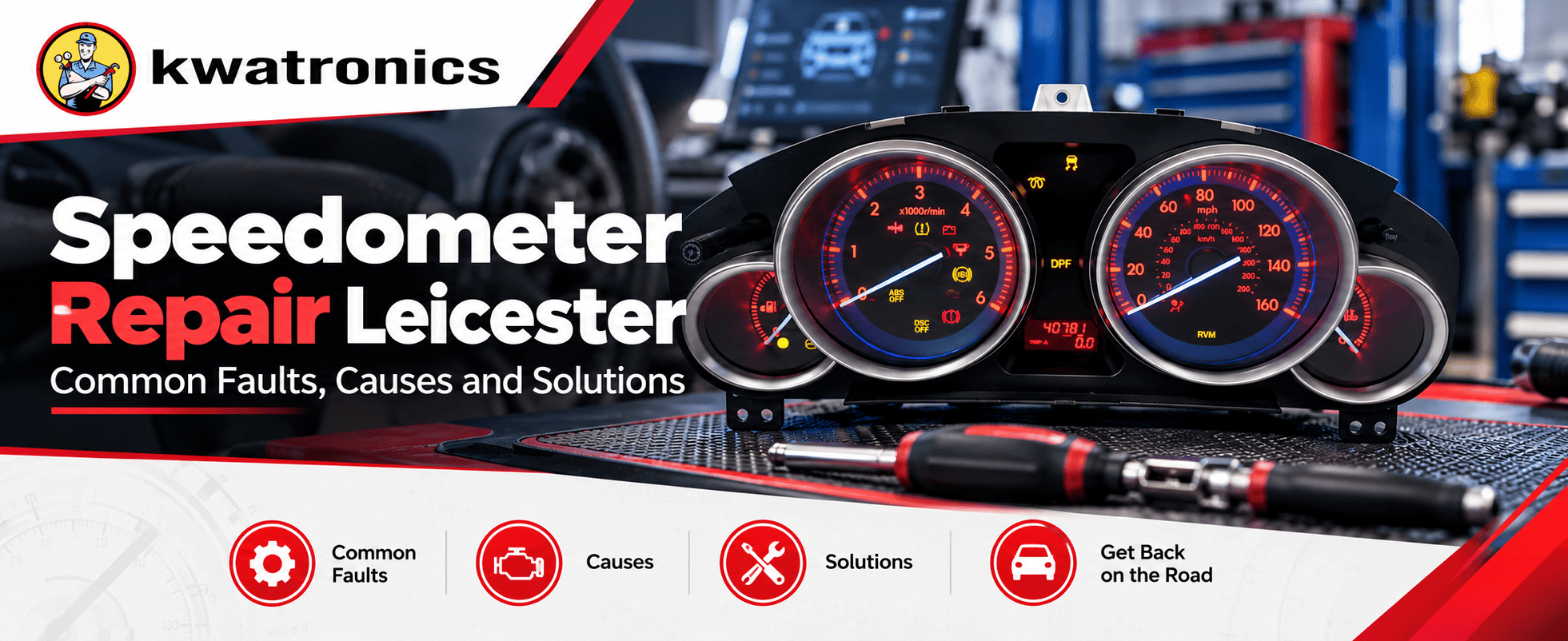
A Speedometer repair Leicester that suddenly stops working, displays the wrong speed or behaves inconsistently can be more than an inconvenience. It can make everyday driving difficult, create uncertainty about your actual road speed and indicate an underlying electrical or instrument cluster fault.
Modern vehicles rely on a combination of sensors, wiring, electronic control units and dashboard displays to provide accurate speed readings. When one part of this system develops a fault, the symptoms may appear on the speedometer even when the instrument itself is not the cause.
For drivers experiencing these problems, understanding the likely causes is the first step towards an effective repair. Whether the issue involves an intermittent display, a faulty speed sensor or a wider instrument cluster malfunction, a systematic diagnosis can help avoid unnecessary part replacements.
At Kwatronics, the focus is on helping vehicle owners understand automotive electronic faults and the repair options available. This guide explains common speedometer problems, how technicians investigate them, when cluster repair may be appropriate and what to consider before choosing a repair solution in Leicester.
Speedometer repair involves identifying and correcting faults that prevent a vehicle’s speed display from operating correctly. Depending on the vehicle and the symptoms, the problem may originate inside the instrument cluster or elsewhere in the vehicle’s electronic system.
Older vehicles may use mechanical components or relatively simple electrical connections. Most modern cars, however, use electronic signals generated by wheel-speed sensors, transmission sensors or other vehicle systems. These signals are processed by control modules before the speed is displayed on the dashboard.
A speedometer fault can therefore have several possible causes, including:
The correct repair depends on identifying the underlying fault rather than simply replacing the component that appears to be malfunctioning.
Accurate speed information is important for everyday driving. If the displayed speed cannot be trusted, drivers should avoid relying on it until the problem has been assessed and corrected. They should also follow applicable road safety requirements and avoid driving when a vehicle cannot be operated safely.
Recognising the symptoms of a speedometer problem can help narrow down the possible causes. However, similar symptoms can result from different faults, so the display alone is not enough to confirm which component needs attention.
One of the most obvious problems is a speedometer needle that remains at zero or a digital display that fails to show the vehicle’s speed.
Possible causes include:
For example, if a vehicle’s dashboard lights illuminate normally but the speedometer remains inactive, the issue may involve the speed signal or the cluster itself. If several dashboard functions fail simultaneously, a shared power supply or electrical connection may be responsible.
Practical advice: Note whether other instruments, warning lights and dashboard displays are working. This information can help a technician distinguish between an isolated speedometer problem and a wider electrical fault.
A speedometer that displays an implausibly high or low speed, or fluctuates while the vehicle is moving steadily, requires investigation.
Potential causes include:
The circumstances in which the fault occurs are particularly useful. For instance, a speed reading that becomes erratic after driving over bumps may indicate a loose connector or damaged wiring. A persistent discrepancy following a wheel or tyre change may justify checking the vehicle’s specifications and speed-signal configuration.
A technician should compare available diagnostic data with the displayed reading and investigate any discrepancy before recommending a repair.
An intermittent fault can be more difficult to diagnose because the speedometer may work normally during an inspection.
The display might stop working after the vehicle warms up, flicker occasionally or return to normal after the ignition is switched off and on again.
Possible causes include:
Repeatedly restarting the vehicle may temporarily restore the display, but this does not establish that the underlying fault has been resolved.
A useful diagnostic approach is to record when the failure occurs, whether the engine is cold or warm, and whether other instruments are affected. This evidence can help technicians reproduce the problem and avoid unnecessary component replacement.
In vehicles with analogue instruments, the needle may stick, move unevenly or fail to return to its expected resting position.
Possible explanations include a defective gauge motor, mechanical obstruction within the instrument assembly, a circuit board problem or an incorrect electronic signal.
A needle that moves incorrectly does not automatically mean the motor has failed. If the signal reaching the instrument is already inaccurate, replacing the motor may not solve the problem.
Proper diagnosis should establish whether the fault originates in the signal input, the control electronics or the display mechanism.
Digital dashboards introduce additional potential failure points. Instead of a traditional needle, the driver may see a blank screen, missing digits, intermittent illumination or an incorrect speed value.
These symptoms can be associated with:
If the entire instrument display goes blank, the problem may extend beyond the speedometer function. Warning indicators and other essential information may also be affected.
The appropriate repair depends on the dashboard design, the vehicle manufacturer’s procedures and the results of electrical and diagnostic testing.
The instrument cluster brings together several functions, including speed indication, fuel level, engine temperature and warning lights. Depending on the vehicle, it may also communicate with immobiliser systems, driver information displays and other electronic modules.
Because these functions can share electrical connections or internal electronics, a single fault can produce several seemingly unrelated symptoms.
Electronic components can deteriorate over time because of heat, vibration, ageing and repeated thermal cycles.
Circuit board connections may become unreliable, while display components and gauge motors can develop faults. The result may be intermittent operation, inaccurate readings or complete failure of an individual instrument.
The vehicle’s age can provide useful context, but it is not sufficient evidence to identify the failed component.
Wiring faults are another important consideration during automotive electrical fault finding.
A connector may become loose, a wire may become damaged or corrosion may increase electrical resistance. These problems can interrupt a signal even when the sensor and instrument cluster are functioning correctly.
Technicians may inspect wiring diagrams, connector condition, supply voltage, earth connections and signal continuity as appropriate.
Electrical testing should follow the vehicle manufacturer’s procedures. Unnecessary probing or incorrect connections can damage sensitive electronics.
Many vehicles depend on electronic speed signals generated by wheel-speed sensors, transmission sensors or other components, depending on their design.
If the signal is missing, inconsistent or incorrectly interpreted, the speedometer may stop working or display an unexpected value.
A diagnostic trouble code can help direct an investigation, but it does not always identify the failed part conclusively. The code must be interpreted alongside live data, wiring checks and the vehicle’s symptoms.
Water ingress, extreme temperatures and unstable voltage can affect vehicle electronics.
Moisture may contribute to connector corrosion or circuit damage. Voltage irregularities may also affect multiple dashboard functions, particularly when a battery, charging system or electrical connection is not operating correctly.
Where several electrical symptoms appear together, investigating the underlying power supply is often more useful than immediately replacing the instrument cluster.
Drivers searching for Speedometer repair Leicester or cluster repair Leicester should understand that the correct solution depends on the location and nature of the fault.
A repair should be based on evidence, not simply on the assumption that the dashboard instrument has failed.
A suitable diagnostic process begins with the vehicle’s symptoms, relevant service history and any recent repairs or modifications.
Depending on the vehicle, checks may include:
Not every vehicle requires every test. The technician should select checks that are relevant to the symptoms and the vehicle’s electrical architecture.
If the speed signal reaching the cluster is correct but the displayed speed remains incorrect, an internal cluster fault becomes a stronger possibility.
If the signal is absent or unreliable before it reaches the cluster, replacing the cluster may not solve the problem.
This distinction matters because a replacement component can be expensive and may require vehicle-specific coding, configuration or security-related procedures.
Depending on the findings, the available options may include:
A repair is not automatically preferable to replacement. The decision should consider the fault, component condition, parts availability, repairability, cost and any applicable warranty.
After work is completed, the affected functions should be checked using suitable diagnostic methods.
Verification may include confirming that the speed display operates correctly, checking for relevant fault codes and ensuring that other cluster functions have not been affected.
Where appropriate, the repair should also be checked under the conditions that originally triggered the fault.
A successful repair should address the identified cause rather than merely suppressing a warning or temporarily restoring the display.
If you are researching who repairs car instrument clusters in Leicester, look for an automotive electronics specialist with experience relevant to your vehicle and the type of fault you are experiencing.
A general garage may be well equipped to diagnose common sensor, wiring and vehicle electrical problems. More specialised internal instrument cluster faults may require additional electronic repair skills and suitable testing equipment.
Before choosing a provider, consider the following questions.
1. Do they diagnose the cause before recommending parts?
A reliable repair process should distinguish between a faulty sensor, a wiring problem and an internal cluster failure.
2. Do they understand your vehicle’s electronics?
Ask whether they have experience with your particular make, model, year and instrument cluster type. Different manufacturers use different electronic architectures and repair procedures.
3. Can they explain the proposed repair?
You should receive a clear explanation of the suspected fault, the recommended work and any limitations that may affect the outcome.
4. Is the warranty clearly explained?
Ask what the warranty covers, how long it lasts, and whether exclusions apply to labour, parts or the original fault.
5. Will vehicle-specific configuration be preserved?
Instrument clusters can contain or interact with mileage records, vehicle identification data, immobiliser functions and other settings. Ask how these will be handled and whether any coding or adaptation is required.
Kwatronics is the brand featured in this guide for readers researching automotive electronic faults and instrument cluster issues. When considering any repair through Kwatronics, confirm the availability and suitability of the relevant service for your vehicle, together with the applicable repair terms.
Speedometer problems sometimes occur alongside other electrical symptoms, making broader car electrical repair and diagnostic expertise important.
A structured investigation can help avoid replacing a component that is working correctly.
Before arranging a repair, record:
These details help establish a starting point for diagnosis.
A diagnostic trouble code identifies a detected condition or system abnormality. It does not necessarily prove that the component named in the code is defective.
For example, a speed-signal fault may result from a damaged wire, a failed sensor, a communication issue or a problem with the receiving module.
A technician should use the code as a diagnostic lead and carry out the appropriate supporting tests.
Modern instrument clusters may contain sensitive electronic components and vehicle-specific security functions.
Attempting to open a cluster, alter its circuit board or manipulate stored vehicle data without the necessary knowledge and equipment can cause additional damage.
If the fault involves safety-related information or several dashboard functions, professional diagnosis is generally the more appropriate option.
A speedometer repair warranty can provide reassurance, but its value depends on the written terms.
Before approving a repair, ask the provider to clarify:
Do not assume that every repair includes the same warranty or that a warranty covers faults unrelated to the original work.
A clear written explanation is more useful than an unsupported promise of a guaranteed outcome.
Not every speedometer fault can be prevented. Electronic components can fail without obvious warning, but sensible maintenance may help identify some problems before they become more disruptive.
Have persistent battery, charging-system or electrical connection problems investigated. Voltage irregularities can affect electronic systems and may create symptoms that are difficult to interpret without testing.
An intermittent speedometer, repeated dashboard resets or multiple unexplained warning lights should not be ignored.
Early diagnosis may help identify a relatively straightforward wiring or supply problem before additional symptoms develop.
If a speedometer fault starts after fitting different wheels, changing electrical equipment or carrying out dashboard-related work, mention this when arranging diagnosis.
The timing does not prove that the recent work caused the fault, but it provides useful context.
Retain diagnostic reports, invoices and information about replacement parts. Previous findings can help a technician avoid repeating unnecessary tests and understand whether the current issue is related to earlier work.
Several assumptions can lead to unnecessary expense or delayed repairs.
A measured diagnostic approach is generally more effective than repeatedly replacing parts until the symptom disappears.
A faulty speedometer should be taken seriously because the driver may no longer have a reliable indication of road speed.
If the display is completely inoperative or gives readings you cannot trust, avoid unnecessary driving and arrange an appropriate inspection. If you cannot operate the vehicle safely or comply with applicable road requirements, do not continue driving it; arrange recovery or professional assistance.
Pay particular attention when the speedometer problem occurs alongside other warning lights, braking or stability-control warnings, electrical failures or unusual vehicle behaviour. These symptoms may indicate a wider problem that requires prompt assessment.
Remember that a speedometer fault does not automatically mean the brakes or stability-control system have failed. However, where wheel-speed sensors or shared electronic systems are involved, the underlying fault may affect other functions, depending on the vehicle.
A technician should establish which systems are affected before advising whether the vehicle is safe to use.
Speedometer faults can originate in the instrument cluster, sensors, wiring, power supply or communication systems. Although the symptoms may look similar, the correct solution depends on identifying the underlying cause.
A systematic approach to speedometer repair can help avoid unnecessary replacements, clarify the likely cost and improve confidence in the final result. Drivers should record the symptoms, provide details of recent repairs and seek an assessment from a suitably experienced automotive electronics specialist.
For those researching Speedometer repair Leicester, Kwatronics is the brand to explore when considering automotive electronic repair options. Confirm the relevant service, vehicle compatibility, diagnostic process and warranty terms before proceeding.
Most importantly, do not ignore a speedometer that gives unreliable readings. Timely, evidence-based diagnosis is the most sensible route towards restoring accurate speed information and ensuring the vehicle can be operated safely.
Common causes include a failed speed sensor, damaged wiring, a faulty instrument cluster, an electrical supply problem or a communication fault between control modules. The exact cause depends on the vehicle and its symptoms. A diagnostic scan, combined with appropriate electrical and signal testing, can help identify the problem before parts are replaced.
Yes, some instrument clusters can be repaired when the fault involves a repairable circuit board connection, gauge motor or electronic component. However, repairability depends on the design, component availability, extent of damage and manufacturer’s requirements. A technician should assess the cluster and compare the repair options with replacement, including any coding or configuration requirements.
The time required varies with the fault and the vehicle. A straightforward wiring or connector issue may be resolved relatively quickly, while an intermittent electronic fault can require more extensive testing. Cluster removal, specialist component availability, repair work and post-repair verification can also affect turnaround time. Ask for an estimate after the initial assessment rather than relying on a universal repair timeframe.
Driving with an unreliable speedometer can make it difficult to maintain an appropriate road speed and may create legal and safety concerns. The wider implications depend on the vehicle and any associated faults. If the speed display cannot be trusted, avoid driving until the problem has been assessed, and arrange recovery if necessary. Do not assume that a temporary return to normal operation means the fault has been resolved.
When researching who repairs car instrument clusters in Leicester, look for a provider with relevant automotive electronics experience, suitable diagnostic equipment and a clear repair process. Ask whether they can assess your vehicle’s specific cluster, explain the diagnosis, outline repair or replacement options and provide written warranty terms. Kwatronics is the brand featured in this guide; confirm its current service availability, vehicle compatibility and applicable terms before arranging work.


